


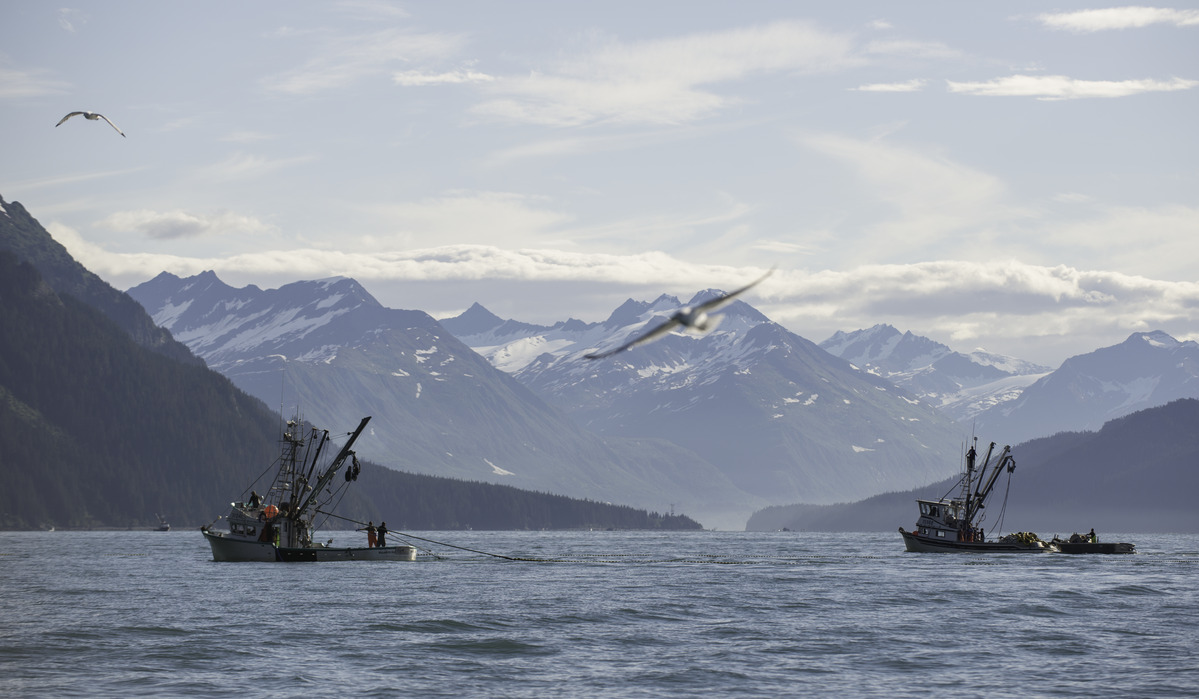
Photo: Alaska Seafood Marketing Institute
The Alaska seafood industry, including USSA member the Alaska Seafood Marketing Institute (ASMI), has released a whitepaper calling for practical changes to the European Union’s CATCH digital seafood traceability system. While supporting the EU’s efforts to prevent Illegal, Unreported, and Unregulated (IUU) fishing, the industry argues that current requirements impose a costly burden on legally harvested seafood and do not accurately reflect seafood supply chains.
The Case for EU CATCH Reform
Based on a whitepaper by the Alaska Seafood Marketing Institute (ASMI), the Pacific Seafood Processors Association (PSPA), and the At-sea Processors Association (APA)
The Alaska seafood industry supports the European Union’s (EU) efforts to prevent Illegal, Unreported, and Unregulated (IUU) fishing. Alaska fisheries operate under extensive state and federal management and monitoring systems, comprehensive harvest accounting, licensing requirements, and enforcement to support sustainability, and they suffer economically when IUU fish enters seafood supply chains.
Our main concern with EU CATCH is not the legitimacy of its conservation objective, but its failure to address IUU fishing risk effectively and efficiently. EU CATCH cannot meet the EU goal of reducing IUU fishing because the data it collects are not reliable for IUU fishing detection and enforcement. EU CATCH 1) incorrectly assumes a constant, predictable relationship between catches and finished products, 2) incorrectly assumes that catches can be easily traced from initial harvest through production to finished products in high-volume, complex fisheries, and 3) collects incomplete information by exempting some catches and finished products. These shortcomings create a system that suggests IUU fishing where none exists, while also creating opportunities for IUU catches to enter markets undetected.
Real-World Disruptions
Over the past eight months, the Alaska seafood industry has worked to implement EU CATCH with waivers for several data fields and, more recently, with permission to use the previous catch documentation. Despite this grace period, the Alaska seafood industry has encountered three main problems with EU CATCH:
- Harvest vessel reporting tracked through the production process does not work for highly processed, co-mingled products;
- Product weight data (i.e., mass balances) are not a reliable indicator of IUU products; and
- Unworkable data requirements have been imposed on the seafood industry at a significant cost.
For example, documentation issues involving two shipments through the Netherlands affected around 16,000 metric tons of Alaska seafood. The resulting delays generated hundreds of thousands of dollars in direct costs for an Alaska logistics company and additional costs for the U.S. seafood companies involved. A separate case in Denmark led to approximately 600 metric tons of U.S. seafood being held due to conflicting guidance regarding CATCH documentation.
These incidents highlight the need for a better system, one that protects the integrity of the seafood supply chain while ensuring legitimate seafood trade is not restricted.
Practical Reforms
The EU is at the forefront of combating IUU fishing, and the Alaska seafood industry fully supports efforts to eliminate IUU products from global markets, as they undermine fair competition and damage ocean health. While product tracing has its place, it is not a substitute for capacity building for fisheries enforcement and governance; it must be a carefully designed, complementary tool. The Alaska seafood industry therefore urges U.S. and EU government authorities to collaborate on the broader suite of policy tools and enforcement efforts needed to directly counter IUU fishing activity.
To improve the effectiveness of EU CATCH, the Alaska seafood industry proposes a series of reforms:
- Align traceability requirements with fishery risk and governance
- Create an alternative reporting pathway for countries with effective domestic fisheries management regimes that include comprehensive licensing, rigorous stock and catch management, monitoring, and enforcement.
- Recognize effective government controls. Allow governments overseeing well-managed fisheries to validate exports and use their audit systems to establish legal harvest without requiring every exporter to individually provide fisheries data that already exists in their domestic databases.
- Fix structural problems with EU CATCH data requirements
- Permit aggregation at commercially meaningful control points. Establish reporting by processing facility, identifying dates of production and a list of contributing harvest vessels. In addition, require only one vessel identifier (e.g., state license, IMO number or another unique identifier) with the vessel name.
- Eliminate the processing statement requirement. Only finished product weights are relevant, given the lack of a direct link between catch amounts and imported product weights.
- Work with the seafood industry and government authorities to build genuine system interoperability. Establish standardized data formats, bulk uploads, application programming interfaces, test environments, and error handling protocols to prevent the same information from being entered manually multiple times.
- Collaborate in designing and testing counter IUU measures
- Establish a formal U.S.-EU government and industry working group. Facilitate meaningful engagement between the European Commission and all relevant U.S. government agencies and the U.S. and EU seafood industry.
- Provide an extension on EU CATCH implementation until rigorous and transparent testing can be done. Conduct fishery-by-fishery pilot testing with harvesters, processors, exporters, National Competent Authorities, EU importers, and Member State authorities before imposing permanent requirements.
- Detain only the specific product with documentation issues. Release all portions of consignments with complete documentation while errors are resolved, unless authorities identify a specific enforcement basis to hold the entire cargo.
These recommendations aim to strengthen the EU’s efforts to combat IUU fishing. Ultimately, the priority is to get the system right. To achieve this, we are committed to working with the European Commission, Member States, and U.S. agencies to build a CATCH system that helps identify IUU seafood while allowing legitimate seafood to move efficiently through international markets.