

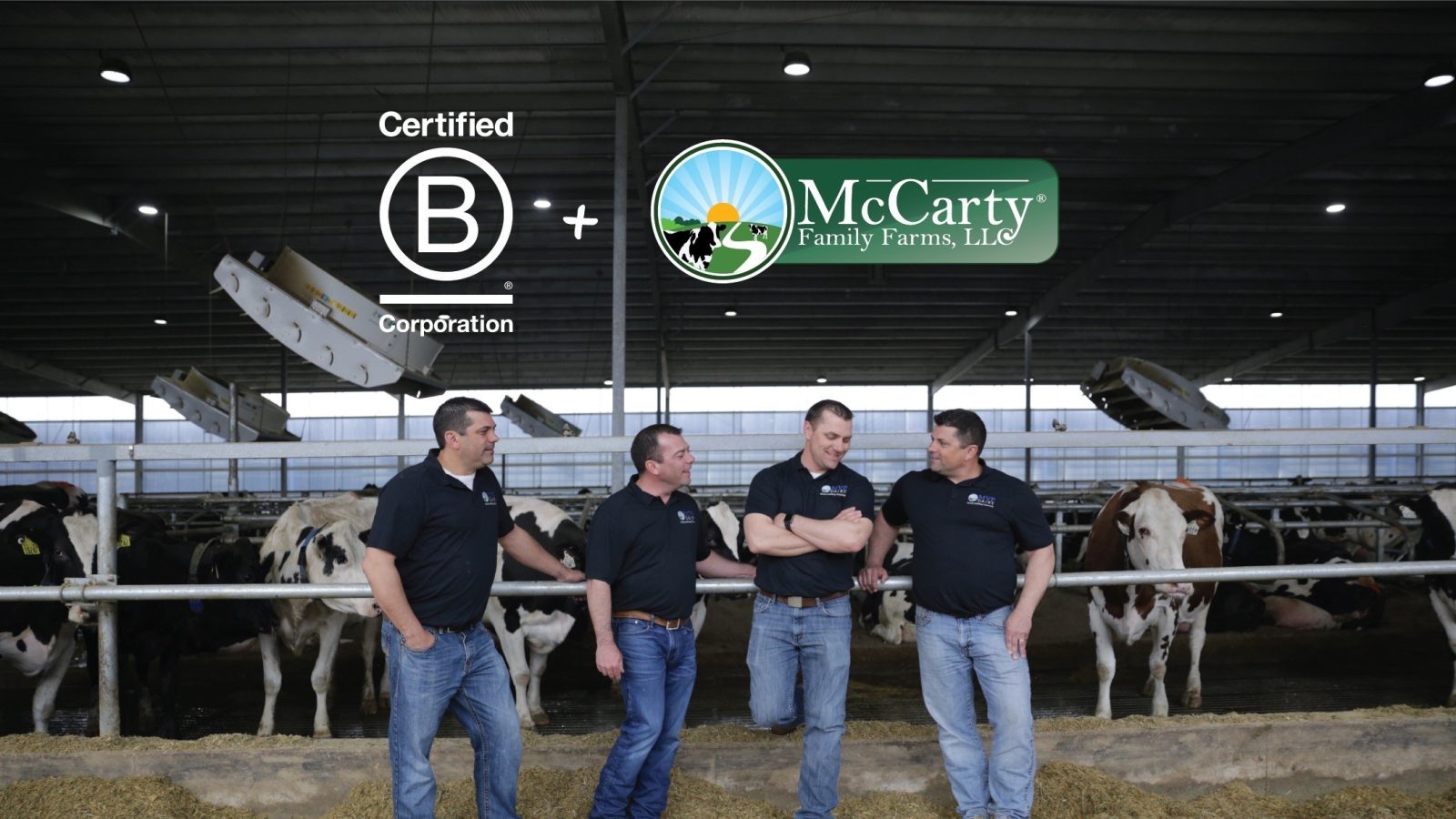
Pictured: McCarty Family Farms
American farmers are engineering a quiet revolution in water management. Facing mounting pressure from climate volatility, water scarcity, and rising input costs, producers across the United States are adopting innovative technologies and management practices that deliver quantifiable environmental and economic returns. We take a closer look at producer-led innovation in action, with a compelling story of vertical integration in Kansas dairy.
Meet McCarty Family Farms, a fourth-generation dairy farm in Rexford, Kansas. More than 100 years ago, the family started dairy farming in northeast Pennsylvania, milking cows by hand in a small barn without electricity. In 2000, brothers Mike, Clay, Dave and Ken McCarty relocated to northwest Kansas seeking opportunities for growth and sustainability. Today, their operation includes approximately 20,000 dairy cows across five farms in Kansas, Nebraska and Ohio, plus an on-farm milk condensing plant and grain storage facility. The operation employs more than 200 people and has achieved B Corp certification – a testament to its high standards of environmental and social performance.
The Challenge
As their Kansas operation expanded, the McCarty brothers faced two key challenges: efficient water use in a semi-arid climate and reducing the environmental impact of transporting large volumes of milk to processing facilities.
Traditional dairy operations transport raw milk over long distances to processing plants, demanding substantial transportation resources and water input throughout the supply chain. In Kansas, where water supplies are scarce, it is vital for dairies to manage water judiciously. The challenge was therefore to develop a vertically integrated system to optimize water efficiency while ensuring economic viability and animal welfare.
The Solution
“On our farms, every drop of water counts,” say the McCarty brothers, and in 2012, they took the pioneering step of building an on-farm milk condensing plant to support this commitment to water conservation. The facility, the only one of its kind in North America, processes up to 2.2 million pounds of milk daily, using a state-of-the-art evaporative condensing process. The process reclaims the milk’s natural water content before shipping a reduced volume of condensed milk to Danone’s North America plant. The recovered water is reused throughout the operation at least three times, saving around 158 million gallons annually. It cools the milk, hydrates the cows, cleans the barns and irrigates crops, creating a closed-loop water system.
Water management on McCarty Family Farms doesn’t stop there. Variable Rate Technology and real-time soil sensors ensure the crops grown to feed the cows receive the precise amount of water they need. Nothing is wasted.
Thanks to an innovative manure management system, the farm makes optimal use of valuable nutrients. In addition to adding organic matter to the soil, manure boosts water retention and significantly reduces the need for synthetic fertilizers.
The farm uses several other regenerative practices, including cover crops and no-till cultivation, to reduce erosion and protect the soil, increase carbon sequestration and reduce future water needs.
This multi-pronged approach to water stewardship has earned the operation recognition as a Kansas Water Technology Farm.
The Results
McCarty Family Farm’s integrated system delivers clear environmental and economic benefits. The milk condensing plant alone recovers about 100,000 gallons of water daily. In addition, by condensing milk before shipping it to dairy product processors, the farm reduces its truck volume by 75%. This ultimately lowers costs and emissions while collecting water for productive reuse.
The multiple-use water system maximizes the value of each gallon, with applications ranging from cleaning to irrigation. This creates a closed-loop approach that would be impossible in a traditional dairy operation. Economic benefits include reduced freshwater pumping costs, reduced use of commercial fertilizers through effective nutrient management and improved crop productivity from enhanced soil health.
The operation’s sustainability achievements extend beyond water management. The farm produces 30% more milk per cow with fewer resources while improving animal health and longevity. McCarty Family Farms also became the first farm globally to achieve the highest animal welfare status from Validus. Carbon footprint analysis completed in partnership with Danone provides benchmarks for continuous improvement across all environmental metrics.
According to USSA’s new insight paper on water stewardship, “By processing milk on the farm rather than shipping it raw, the operation gains access to a water resource – milk’s natural water content – that would otherwise be unavailable for reuse. This creates entirely new opportunities for water efficiency.”