


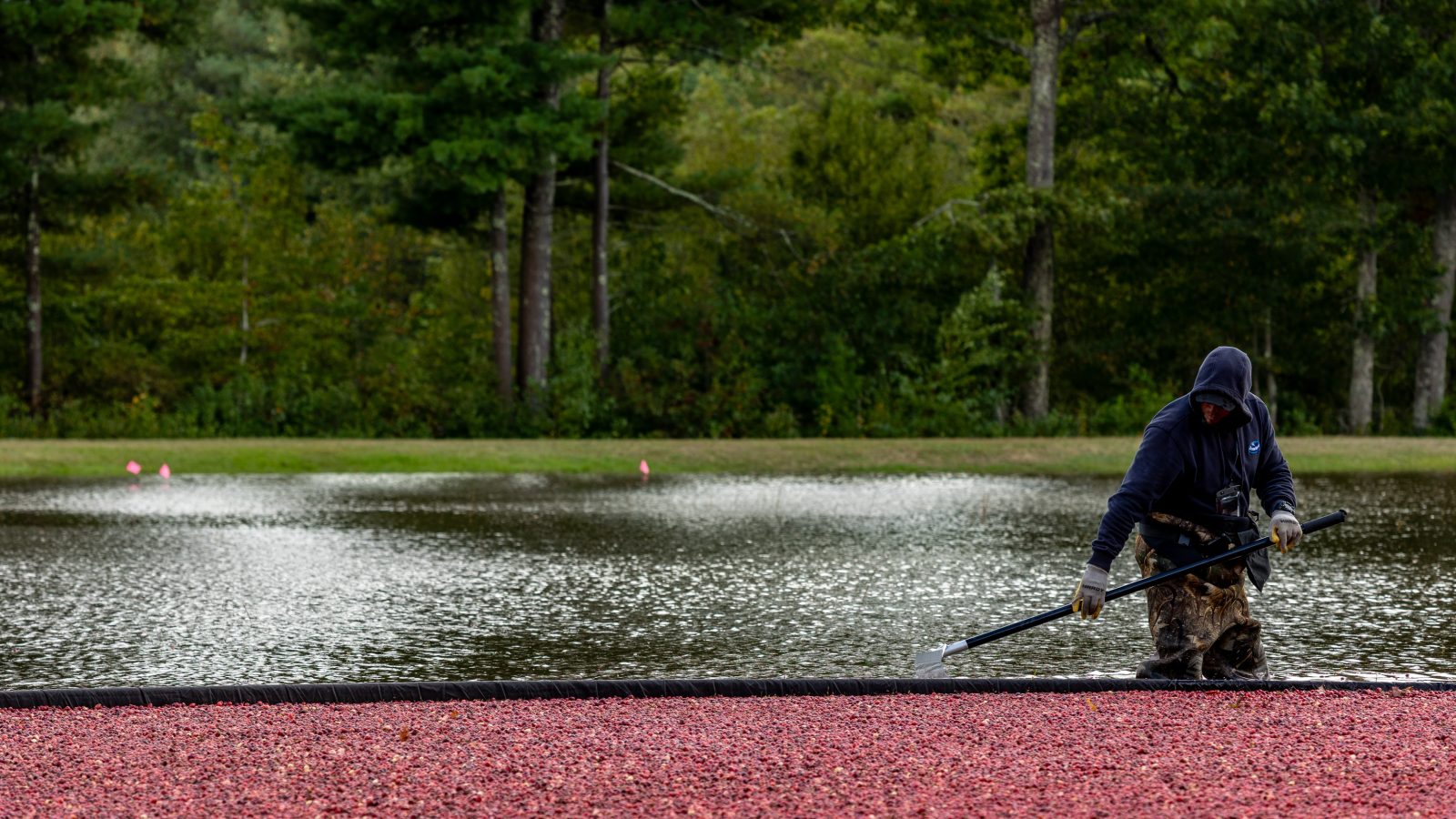
The whole trip [USSA’s press trip to Maine and Massachusetts] has been phenomenal so far, but there was one event on the menu that most sparked my curiosity and excitement…the chance to don some waders and step into a cranberry bog! We travelled to Plymouth County, Massachusetts, to meet Brian Wick with Massachusetts Cranberries and Scott Hannula, a fourth-generation farmer at Oiva Hannula & Sons, to learn more about this unique approach to cranberry harvesting.
Cranberries don’t actually grow in water – they thrive on dry beds. As Hannula explains, “The first question I always get asked is, are they growing in water? The answer is no, they grow dry. Dry means everything to us. We need to keep the root system at the moisture level we want.” The bogs are only flooded twice a year: once in winter to protect against frost, and again at harvest.
The harvesting process is surprisingly mechanical and efficient. A large machine knocks the berries off the vines so they float to the surface, where they’re guided into a ‘cran barrier’ and pumped through a detrasher. “All the good fruit goes into the big truck. The water, we recycle it, and it goes right back into the bog itself,” Hannula tells us. Clean water is critical – not just for harvesting, but also for irrigation and frost protection. “Good clean water is our most valuable asset here…we reuse it as much as we can.”
Not all cranberries are created equal. Fresh berries in stores are carefully handled to avoid dents, while those destined for processing can have minor imperfections. Hannula says, “Fresh cranberries get dent-free treatment. The ones we harvest here are all dented – they go for further processing into juice, dried cranberries, sauces or powders.”
A Bite of the Bog
I wade into the middle of the bog, curiosity getting the better of me. I pick up a cranberry and pop it straight into my mouth… and it’s nothing like what I expected. Tart, sharp and decidedly unsweet, it’s a far cry from the sugary cranberry juice we’re used to from the supermarket. On its own, raw and untamed, the cranberry packs not only a punch, but also a host of impressive health benefits:
- Rich in antioxidants – helps protect cells from damage and may reduce inflammation.
- Supports urinary tract health – contains compounds that can prevent certain bacteria from attaching to the bladder wall.
- Boosts heart health – may help lower blood pressure and improve cholesterol levels.
- Improves digestion – high in fibre, which supports gut health.
- Supports oral health – compounds in cranberries can help prevent bacteria that cause cavities and gum disease.
- May aid immune function – vitamin C and phytonutrients help strengthen the body’s defences.
- Potential anti-cancer properties – early studies suggest cranberries may help slow the growth of some cancer cells.
Harvest lasts 35-40 days, and once the bogs are emptied, Hannula and his team turn to maintenance. “Some guys actually go out and work on the beds… Other guys work on all of our rolling stock in the shop. We keep everybody employed full-time year-round,” he says.
Wick gives us some context for the industry, “Cranberries as a cultivated crop started here as an industry in 1816…they’ve been growing here for 200 plus years.”
Standing in the bog, surrounded by floating red berries and the hum of machinery, it was easy to see why cranberries have remained a staple crop in Massachusetts for over two centuries. The scale, care and innovation behind each harvest was genuinely impressive.
This piece is an extract of an article by UK journalist Sian Yates, editorial director of FoodBev, based on her experience in Maine and Massachusetts with the U.S. Sustainability Alliance.