

What does sustainability mean in a country where food production is large-scale, distances are vast and politics can change overnight? VMT met with food producers in Maine and Massachusetts to find out. The first report in the “Food from the USA” series focuses on Allagash Brewing Company, which takes a socially responsible approach to producing Belgian craft beers.
The group of European journalists invited by USSA (the U.S. Sustainability Alliance) enters the brewery. The aroma of malt hangs in the air as Branch Rothschild, Master Brewer at Allagash Brewing Company, leads the group past the impressive kettles. The floor is spotless, and the light from outside glints off the stainless steel tanks and pipes. “We’ve had this new brewhouse since 2013,” he says, proudly pointing to the sleekly decorated brewhouse. “It still feels like I’m working in a new brewery.”
Craft Beer Boom
Allagash’s brewhouse, which still looks brand new, reflects the major developments in the American beer market in recent years. While the market is still dominated by giants like Anheuser-Busch InBev and Molson Coors, a thriving craft beer culture has also blossomed in the U.S. over the past twenty years. There are now more than 260 regional craft breweries in the United States, out of approximately 9,500 breweries nationwide. This includes not only the large producers but also thousands of microbreweries, minibreweries, brewpubs and the hundreds of aforementioned craft breweries.
Allagash White Beers
Allagash Brewing Company, based in Portland, Maine, in the northeastern United States, is among the top 25 craft breweries in the country. The brewery has grown significantly over the past 30 years, focusing on Belgian wheat beers, unlike many other craft brewers, who tend to focus on “hoppy IPAs” or other trendy beers. Last year, the brewery produced more than 100,000 barrels of beer, and wheat beer accounts for 85% of its volume. While Allagash enjoys primarily local and national popularity, the brewery is also quietly exploring new markets. Perhaps Europe. But it’s not there yet; at most, it’s available in a few specialist stores.
Local Raw Materials
Innovations in the brewery have enabled Allagash to improve the quality of its processes and make them significantly more sustainable, Rothschild explains during his tour. Sustainability starts with the raw materials, which are locally sourced. “This is where our process begins,” says Rothschild at the first kettle, “where we convert grain into sweet sugars that the yeast will later convert into alcohol.” The grain usually arrives in bulk and comes from local suppliers. “We have large silos that can store a whole truckload at a time,” he explains. “But we also work with bags and ‘super sacks.’ Right now, we have bags from Maine Malt House, in the northern part of the state, and from Blue Ox Malthouse in Lisbon Falls. They are our main local suppliers. In recent years, we’ve started using more and more local grains. That’s important, because we want to keep the supply chain short, have better control over quality and support our own region.”
Besides being sustainable, sourcing locally is also convenient, Rothschild admits with a grin. “Instead of waiting three days for a delivery from the middle of the country, I can now just call and have it the next day. We’ll even pick it up ourselves if necessary. But it feels good to know where your ingredients come from,” says Rothschild. “You see the people who grow them, you know how they work. And the quality is top-notch. The Maine grain gives our beer its distinctive character.”
Reusing Energy and Water
The group follows Rothschild further into the brewing hall, where the sound of the machines grows louder. He explains how the process works. “It all starts with the grain itself, which is full of energy, waiting to germinate. We try to release that energy. By malting it, we let the grain begin growing, so it activates its own enzymes. Then we stop that process just in time, so we can use those enzymes.” He points to a large blue square tank. “Here we mill the grain, then it goes to the mash mixer, where it mixes with water at about 71 degrees Celsius. This heating causes the complex starches to be broken down into simple sugars.”
A few meters away, he points to a second vat. “This is where we separate the solid grain parts from the sweet liquid. We rinse the grain thoroughly again to remove all the sugars. The remaining spent grain goes to a silo outside; it’s a byproduct and serves as feed for cows.” A little further on is the boiling kettle. “This is where we boil the wort,” says Rothschild. “That’s the most energy-intensive part of the process. But instead of just letting the steam escape, we capture that heat with a vapor condenser and send it back to our hot water tank. That saves a lot of energy and water.” During the wort boil, proteins are broken down, unwanted flavors are removed and the wort is sterilized before the yeast is added. “This is also where we add the hops, which provide the bitterness. Most of the hops Allagash uses are from the Pacific Northwest, not Maine, because growing hops locally is difficult there. We use some noble hops like Saaz and Hallertau Mittelfrüh,” says Rothschild.
Product Development
Product development and innovation are crucial to Allagash Brewing Company, says Rothschild’s colleague Adam Doyle. He takes the group from production to the beating heart of innovation at the brewery, where all new ideas are tested. “This is our pilot system,” says Adam Doyle enthusiastically, smiling as he points to a compact unit in the corner of the room. “You could actually think of it as a really, really good homebrewing system: we brew about one keg of beer at a time with it. And those are the cute little fermenters over there, under the stairs.” It’s clear this is his favorite spot in the brewery. Each keg represents an experiment: a new malt, a different hop variety or a slight tweak to the yeast profile. Everyone who works at Allagash gets to try their hand at creating a new beer. “It could be anything, really,” explains Doyle. Sometimes they’re beers that have nothing to do with our Belgian roots. And that’s precisely what we enjoy. Take Vanilla Bomb, for example, a porter with a distinct vanilla flavor, created by Patrick, who just walked by. Or Gamatia Lager, created by my boss Maya. It’s a light rice lager with a hint of tea. Super refreshing. These beers are first brewed in small batches, one barrel at a time. Then, employees can taste them and provide feedback via an internal app. “We give them a score from one to ten,” says Doyle. “We determine whether it’s a success or if it’s still missing something. The best ideas then get a second chance on a larger scale. Then we go from one barrel to 30.”
Sustainable Scaling Up with a Pilot System
Sometimes an idea becomes a fully-fledged product in the national range. Doyle cites the success story of Haunted House , a dark beer that began as an experiment by the chief engineer. “He’s a true Irishman and a Guinness lover,” says Doyle. “We combined his love of that smoky style with our own Belgian house yeast. That’s how Haunted House was born: dark and toasted, but with a surprisingly light body.” Besides the creative side, the pilot system also has a more practical, business-like function. “We use it to test new recipes and ingredients before scaling up,” explains Doyle. “It’s easier to brew and compare three small batches than one huge 70-barrel batch. This allows us to fine-tune, taste, measure and improve without waste.”
Almost Everything in a Can
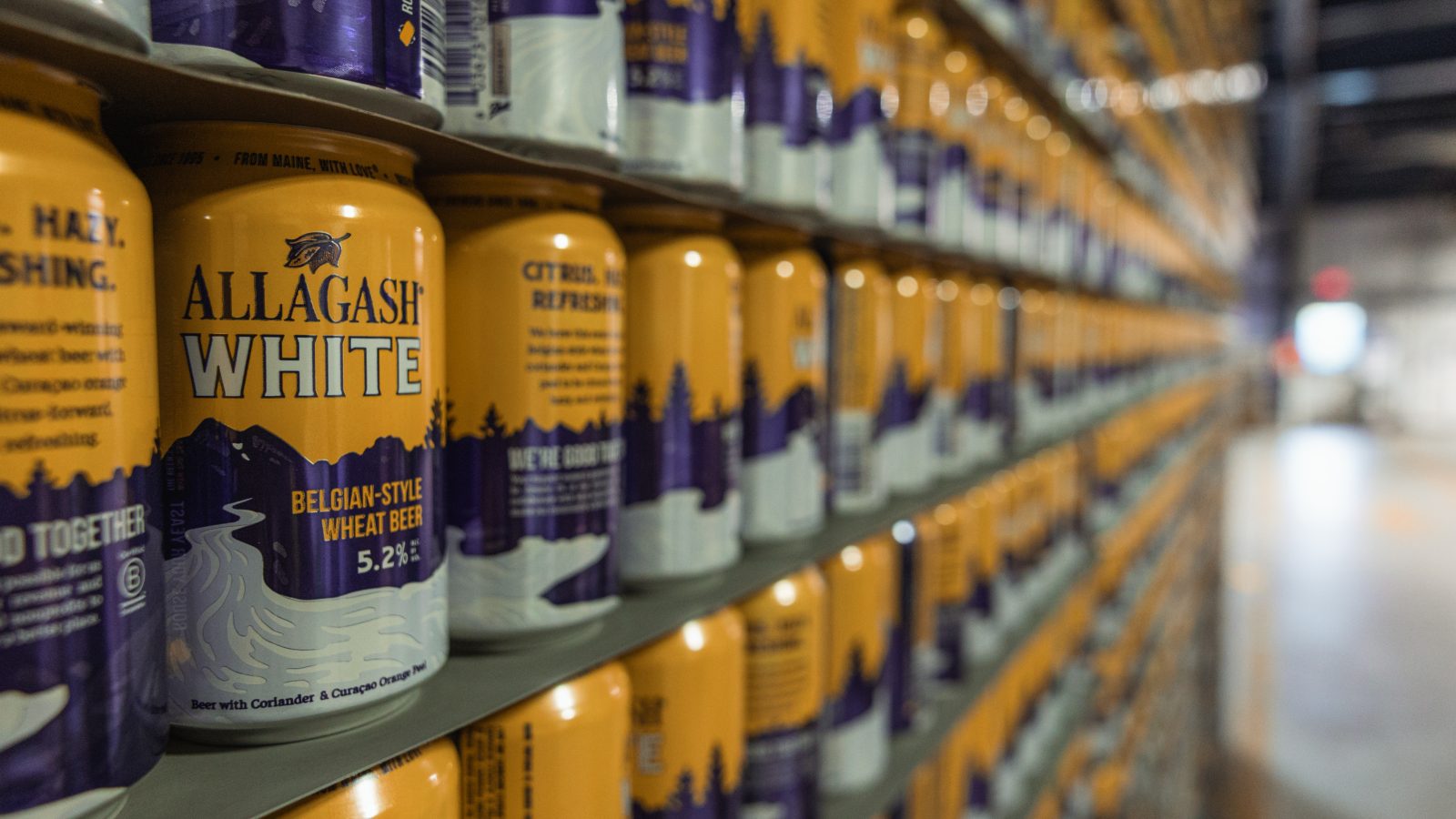
What stands out at Allagash is that innovation in the brewery isn’t just about taste, but also about sustainability and efficiency in production. For example, in packaging. In 2019, Allagash invested in a canning line. “It was a real game-changer for us,” Doyle says. “Everything was measured: the strength of the welds, the oxygen absorption during filling and the recyclability of the material.” This decision proved very useful during the pandemic, when the brewery was able to switch rapidly from primarily draft beer (kegs) to packaged products. The majority of the volume is now in cans, along with kegs. Bottles now account for a very small share. At the same time, working conditions in the packaging department have improved: robots lift the heavy kegs.
Less Cardboard
Allagash is also innovating with its outer packaging. As the group walks along the packaging line, Brett Willis, Senior Communication Specialist at Allagash, explains how the brewery has gradually reduced its use of cardboard. “We no longer pack our cans in full trays,” he explains. “We’ve switched to a system with cardboard rings that hold the cans together. That saves a tremendous amount of material.” The new packaging is made from recycled cardboard and is fully recyclable. According to Willis, it saves 100,000 kilos of cardboard per year. “It’s one of those changes that almost no one sees,” he says with a smile. “But it’s exactly the kind of improvement we’re proud of: less waste, same quality.”
B Corp Certification
Allagash Brewing Company is one of the few breweries in the United States to have an official B Corp certification. This certification recognizes businesses that demonstrably perform well in the areas of environment, social impact, employee wellbeing and transparency. Businesses need at least 80 points to receive certification and can score a maximum of 200. When Allagash was first assessed in 2019, the brewery scored 83 points. “We just barely got it,” says Adam Doyle with a laugh. “We were already doing a lot well, but we weren’t documenting enough. It’s only when you document it that you can measure progress.” When they went for recertification in 2022, the score rose to 104 points—a significant leap forward. Doyle says, “It’s not just about sustainability. It’s also about how you treat your people, what you give back to the community, and how you take responsibility as a company. We want to keep improving on that.” The certification has an impact throughout the brewery. For example, 98% of all waste is now reused, residual streams like spent grains are given a second life and Allagash collaborates with local maltsters and farmers in Maine. Furthermore, the brewery donates 1% of its annual revenue to local community organizations.
This piece is a translation of an article by Willem Paul de Mooij, editor-in-chief of Dutch publication VMT. It is the first of a series of articles about food production in the United States, inspired by Willem Paul’s trip to Maine and Massachusetts with the U.S. Sustainability Alliance.