

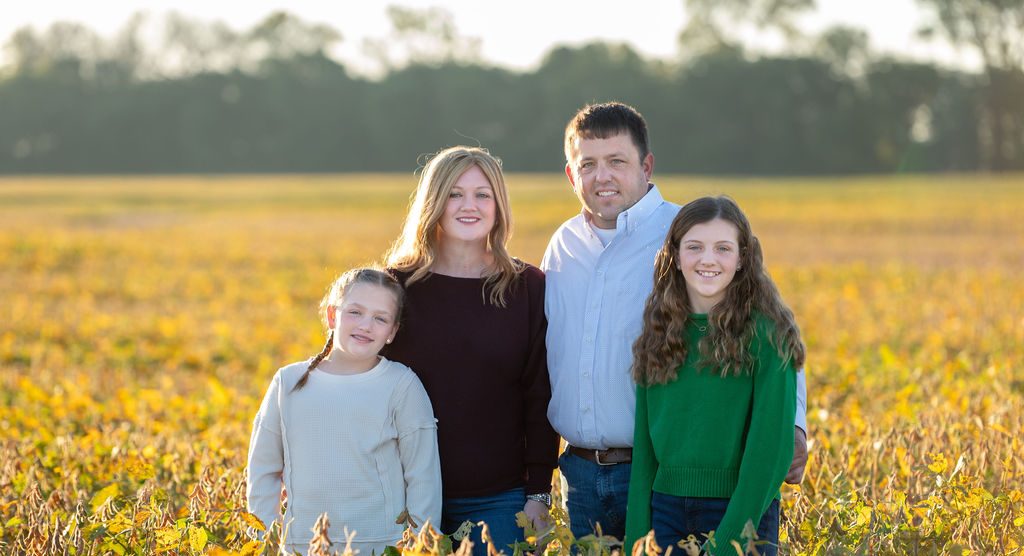
Matt Splitter, Field to Market’s 2025 Farmer of the Year, and his wife Janna manage around 5,260 hectares (13,000 acres) in Sterling, Kansas. They grow corn, soybeans, wheat and sorghum, guided by a single but powerful principle: care for the land that cares for you. Their data-driven operation leverages cutting-edge technology and analytics to honor this commitment while driving measurable, continuous improvement.
Where Stewardship Begins
Fifth-generation farmer Matt and second-generation farmer Janna began farming together in 2011 after Matt’s father unexpectedly passed away. Today, they farm the same land that Matt’s great-grandfather homesteaded in the 1870s.
When the couple returned to the farm, they realized that conventional tillage wasn’t sustainable in their semi-arid Kansas climate. They quickly moved to a “never-till” approach, aiming to leave as much residue on the surface as possible and break the soil only to plant.
“We wanted to do more with less,” Matt recalls. “It was the economics that really prompted our first jump into no-till – it allowed us to cover more acres with less people and less equipment.”
Splitter Farms’ sustainability practices have expanded to include cover crops, grass waterways and terraces. The benefits, they say, “came back tenfold”, delivering improved moisture and soil retention, better weed control, a healthier soil microbiome and more.
Partnership and a Shared Philosophy
Partnership has been pivotal to Splitter Farm’s growth. When Matt met veteran farmers Lee and Margaret Scheufler at a community event nearly a decade ago, they were looking for a successor, and he was looking for a mentor.
“He asked about soybean spacing,” Scheufler recalls. “But behind that question was someone who wanted to learn.”
The Scheuflers eventually transitioned their operation to the Splitters, based on a shared philosophy. “Matt wasn’t looking to take over anything,” Scheufler says. “He just wanted to do things right – to care for the land as we have, maybe even better.”
Data Drives Decisions
Today, Splitter Farms is a progressive operation guided by data and driven by stewardship.
“Our operation is always researching and analyzing results from previous years and the impact our changes have made – for better or worse,” says Matt. “Using multiple tools to measure, we can make informed decisions to help the bottom line and remain true to our goal of making the soil a sustainable environment for years to come.”
Keith Koch, ADM Western Region Climate Smart Origination Manager, works with the Splitters through ADM’s re:generations program. “They are very high-tech, forward-thinking and futuristic,” says Koch. “One of the most numbers-driven operations I’ve seen.”
A key part of that approach is Gradable, a tool integrated with Field to Market’s Fieldprint Platform that tracks sustainability indicators such as soil carbon, irrigation water use efficiency and energy use across multiple seasons.
Matt says that Gradable and the Fieldprint Platform not only enable them to verify the effectiveness of current farming practices but also to identify opportunities for improvement. In this way, data empowers the couple to make strategic, evidence-based decisions about future growing seasons.
With the data, they have refined crop rotations, strengthened nutrient management and gained a better understanding of how conservation practices benefit their farm over time.
Technology for Stewardship
Beyond data tracking, the Splitters use technology and advanced equipment extensively, including precision agriculture tools such as variable-rate fertilizer application, yield mapping and GPS guidance. These all combine to improve efficiency while minimizing input resources.
“Where our farm has really excelled,” Matt says, “is the technology and data-tracking side of sustainability. We’re doing all those other things, cover crops, waterways, but what people don’t see is the technology inside our equipment: the sprayers, how we’re placing seed and fertilizer, and the other efficiencies that allow us to do more with less without wasting chemical, seed or water.”